

Finding your weakest link
to buy more years
of independent living!
96 questions. About ten minutes. Free, and nothing you enter is sent anywhere.
where your resources go
Do the basics first.
Then earn the fancy stuff.
The interventions with the strongest evidence in longevity medicine are also the cheapest, and almost nobody does them, because there is nothing to sell. Start by finding out where you actually stand. Then fill the first bucket. Everything else can wait its turn.

Most people start at bucket three.
Move. Eat well. Sleep. Stay connected. The four pillars.
Blood pressure. A1c. DEXA. Coronary calcium. Deprescribing.
IV drips. Peptides. Whole-body MRI. Cancer panels. Fifty supplements.
They book the IV drip and the full-body scan while their blood pressure goes unmeasured and they haven't stood up from a chair without their hands in a decade. That isn't stupidity. It's what the entire industry sells.
We are not against bucket three. Dr. Peterson files it under recreational anti-aging: if you enjoy it and can afford it, help yourself, same as a weekend in Las Vegas. The objection is buying it while bucket one sits empty.
Why any of this is urgent
Everything peaks.
Then it slopes.
Every system in your body rises to a peak, then declines at some rate, and somewhere below there is a floor: not a number, an event. A fall and a broken hip. Dialysis. Oxygen. A heart attack.
The distance between where you are now and that floor is your reserve. It is measurable, it differs wildly between your own systems, and you almost certainly don't know any of yours.
Understand the model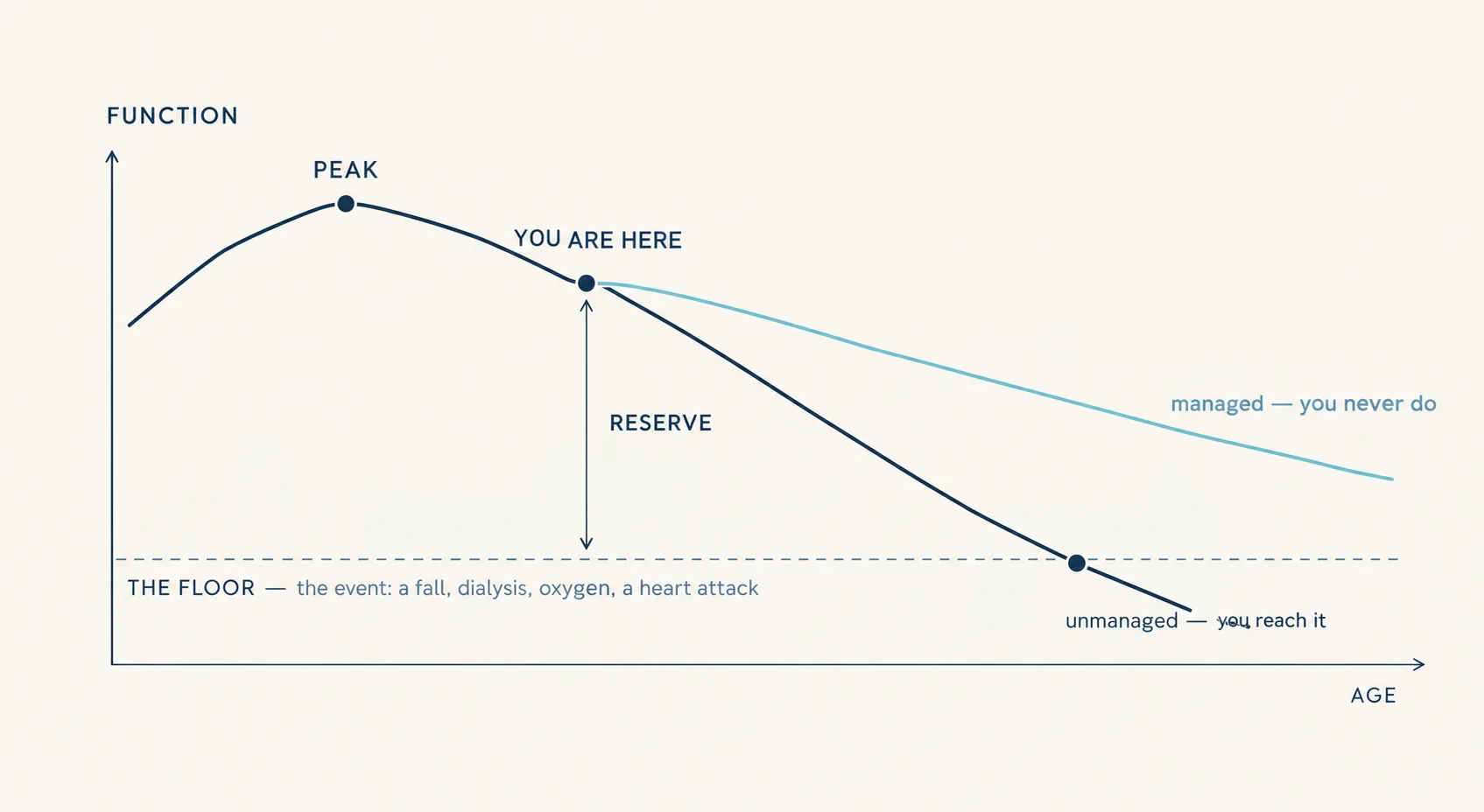
Accept, and change
Half of this is not your problem.
Your eyes are going to stiffen. You will lose distance vision. You can eat perfectly and train like an athlete and it will happen anyway, so accept it, and stop spending worry on it.
Your kidney function falling because your blood pressure and blood sugar are unmanaged is not the same thing at all. It is silent, it is doing damage you cannot feel, and it is entirely changeable.
The wisdom to know the difference is the whole product. What's fixed, what isn't.

Bucket 01 · The Basics
Bucket #1 is the basics. All four of them.
Move. Eat well. Sleep. Stay connected. Strongest evidence in the literature, lowest price tag in medicine, and the things to do before you spend a dollar on anything else. There is no order inside this bucket: show up for any one, stay for all four.
The body is a rebellion. Train it like one.
Strength circles Monday and Thursday. Sunrise trail walks. Ocean swims. Balance and mobility for anyone who needs it.
Cook like you plan to be here a while.
Twice-monthly kitchen salons. Mediterranean basics adapted for island kitchens. You leave with containers for the week.
The pillar nobody can sell you.
Glymphatic clearance, deep sleep after sixty, and the dementia evidence: a measurable trajectory like any other system.
Showing up is the medicine.
Story circles, potluck Fridays, buddy check-ins, and purpose as a measurable intervention.
Why it has to be together
Information is not an adherence mechanism.
Knowing what to do has never once made anyone do it. Telling someone to eat better and move more does not help them eat better and move more. Company does. That is the entire reason the ohana exists: a real week, in person, with people who notice when you don't turn up.
Sunrise trail walk at Lanikai Pillbox
Strength circle · all levels
Sunrise trail walk at Lanikai Pillbox
Strength circle · all levels
Sunrise trail walk at Lanikai Pillbox
Strength circle · all levels
Sunrise trail walk at Lanikai Pillbox
Strength circle · all levels
Sunrise trail walk at Lanikai Pillbox
Strength circle · all levels
Know where to aim
Start the Assessment.
Ninety-six questions, one at a time, about ten minutes. At the end you get the system closest to its floor, and three honest routes to doing something about it.
Schedule a free visit
Bucket 02 · Measure, and ask
Then talk to your doctor about it.
Past this point it is medical care, and we do not deliver medical care. What we can do is make sure you walk into that appointment with a much better list: the handful of cheap, high-yield tests almost nobody thinks to ask for, and one question hardly anyone asks at all:
Do I still need all of these medications? A statin started at seventy takes years to pay off while the side effects start now. The risk-benefit that made sense a decade ago may not be the one you’re living in.
Schedule a free visit
Voices from the ohana